Nanotechnology and Health: A Drop of Saliva That Could Revolutionize Home Disease Testing
- July 10, 2025
- 0
In any ordinary room, a single drop of saliva could reveal the invisible and potentially change the course of a life.

In any ordinary room, a single drop of saliva could reveal the invisible and potentially change the course of a life.
UC Berkeley researchers combine nanotechnology and AI to detect serious diseases at home in under 12 minutes.
Engineers at the University of California, Berkeley (UC Berkeley) have developed an innovative at-home test capable of detecting COVID-19, sepsis, and cancer with extraordinary sensitivity in under twelve minutes, according to Nature Communications.
The test combines nanotechnology, the “coffee-ring effect,” and an artificial intelligence application, promising to surpass the accuracy of traditional home tests and facilitate early detection of serious diseases even in low-resource environments.
During the pandemic, home tests allowed for rapid diagnosis, but they had limitations compared to laboratory methods, producing false negatives in early stages. Current lateral flow immunoassays (LFIA) fail to detect biomarkers at very low concentrations, as required for sepsis or certain types of cancer.
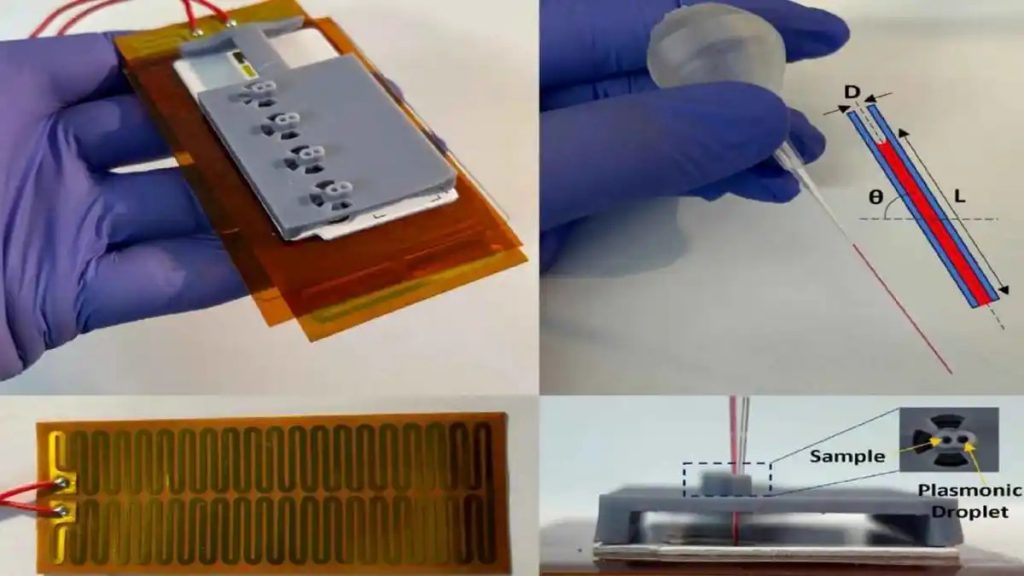
The procedure is simple: the user places a drop of saliva or nasal swab sample onto a special membrane. As it dries, it forms a “coffee-ring effect” pattern. Then, a solution with gold nanoparticles binds to specific biomarkers. Finally, an AI-powered app analyzes the ring, quantifies the biomarker concentration, and delivers the result within minutes.
Sepsis, for example, requires early detection for survival. Biomarkers like procalcitonin (PCT) appear in minute levels (picograms per milliliter), undetectable by conventional home tests. The combination of the coffee-ring effect and plasmonic nanotechnology enables detection at these ultra-low concentrations.
Experiments showed that the UC Berkeley test offers up to 100 times higher sensitivity than conventional home tests for COVID-19, detecting PSA at 3 pg/ml, crucial for early prostate cancer detection. It surpasses lateral flow assays by three orders of magnitude and quadruples the sensitivity of modern ELISA methods.
The kit includes nanofiber membranes, glass microtubes, a small portable heater, and 3D-printed guides for each step. Users simply apply the sample, add the solution, take a photo, and let the app automatically interpret results, removing human error.
Principal investigator Kamyar Behrouzi highlighted: “This simple technique can provide highly accurate results in a fraction of the time of traditional methods.” Senior author Liwei Lin noted it could allow regular home screenings for diseases like prostate cancer, democratizing health and bringing high-precision diagnostics into every household.
While the coffee-ring effect has been explored for sensors before, UC Berkeley’s novelty lies in combining it with nanotechnology and AI algorithms. T
ests with real human saliva confirmed that accuracy is maintained even in complex biological matrices. The full process takes under twelve minutes, with sensitivity and specificity comparable to or exceeding laboratory standards.
This breakthrough promises to transform rapid, accessible diagnostics, opening the door to a new era of public health where early detection is within everyone’s reach.