Long Island: Singapore’s mega-bet to tackle climate change in Asia
- July 24, 2025
- 0
The artificial island megaproject combines coastal defense, water management, and urban expansion to prepare Singapore for rising seas.

The artificial island megaproject combines coastal defense, water management, and urban expansion to prepare Singapore for rising seas.
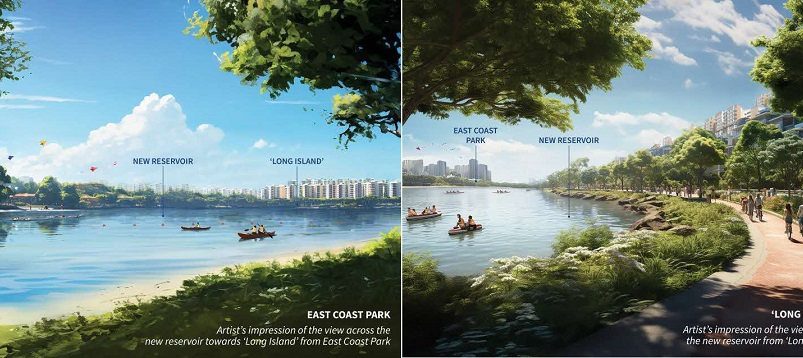
Singapore has taken a bold step in the fight against climate change with the announcement of Long Island, a 12.8-kilometer chain of artificial islands.
Designed as a coastal defense, habitable land, and freshwater reservoir, the project directly responds to rising sea levels and redefines the city-state’s relationship with its coast, setting a global benchmark in urban and environmental planning in Asia.
Authorities project sea levels could rise by up to 1.15 meters by the end of the century and 2 meters by 2150 in high-emission scenarios. Combined with storm surges and extreme tides, water levels could climb as much as 5 meters above current levels, threatening about 30% of national territory.
The Urban Redevelopment Authority (URA) unveiled an initial plan for three reclaimed plots connected by tidal gates and pumping stations, spanning 7.6 km²—two and a half times the size of New York’s Central Park. Singapore’s coastal defense investments could total S$100 billion (US$78 billion) over the next century.

Long Island alone will require 240 million metric tons of reclamation material. Decades will be needed to reclaim, settle, and prepare the land for housing and infrastructure.
Land reclamation has long shaped Singapore. Since the 19th century, the country has expanded its landmass by 25% through reclamation. Lee Kuan Yew, the nation’s founding father, stressed the importance of building not for the next election, but for the next century.
Beyond serving as a seawall, Long Island is envisioned as a vibrant new urban space. The project includes 30,000–60,000 housing units, over 19 km of coastal parks, and a massive freshwater reservoir that will enhance water independence from Malaysia and meet doubled demand expected by 2065.
Environmentalists warn of risks to local species such as horseshoe crabs and hawksbill turtles, and of reliance on sand imports from neighboring countries. Still, the ruling People’s Action Party has made Long Island central to its climate resilience agenda, signaling its status as a state-level priority.
Other nations are exploring similar strategies. Indonesia has proposed a giant seawall for Jakarta, Thailand and the Maldives are considering artificial islands, and Denmark is building an artificial peninsula to protect Copenhagen.
Unlike these projects, opposition in Singapore has been minimal, underscoring national consensus around climate urgency.
With Long Island, Singapore is not only fortifying its shores but also positioning itself as a global leader in climate resilience and forward-looking urban innovation.