Mystery in Chernobyl: Blue-coated dogs puzzle scientists in Ukraine
October 31, 2025
0
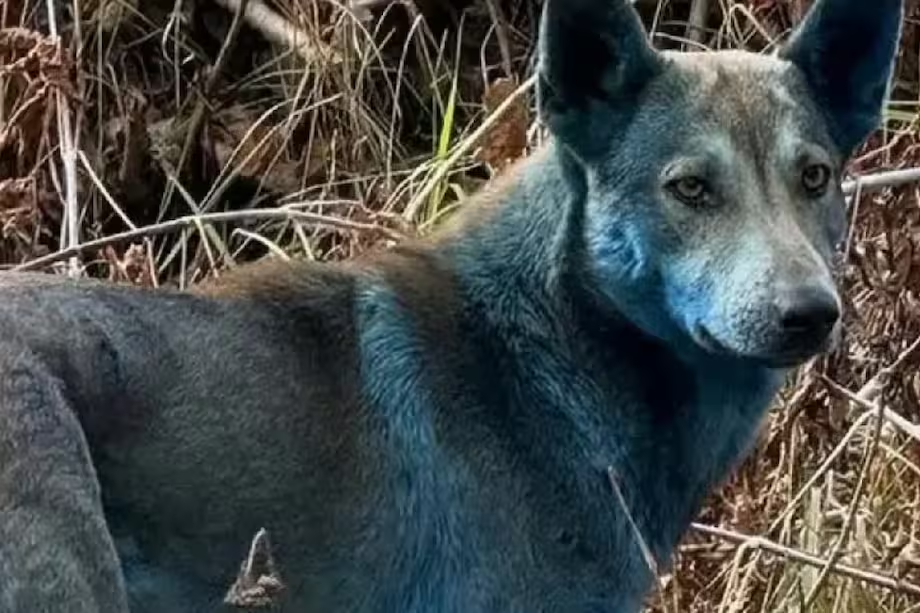
The appearance of several blue-coated dogs near the Chernobyl nuclear plant has sparked concern. Experts are investigating whether radiation or chemical exposure is to blame.
A group of blue-coated dogs was spotted recently in the Chernobyl exclusion zone, in northern Ukraine.
The organization Dogs of Chernobyl, responsible for monitoring and caring for the animals that inhabit the area, released images showing several dogs with an intense blue hue — something never before seen in the region affected by the 1986 nuclear disaster.
The discovery was reported on Monday, October 13, when volunteers noticed the animals wandering near the nuclear plant and the city of Chernobyl.
“They weren’t blue last week. We don’t know the reason and are trying to capture them to find out what’s happening,” said the team in a video shared on social media.
The news surprised both caretakers and scientists, who had never observed anything similar. Although the exact cause remains unclear, preliminary hypotheses suggest contact with chemical residues or industrial dust still present in abandoned structures within the exclusion zone. “Most likely, they came into contact with a chemical substance,” said Dogs of Chernobylvolunteers.
Since 2017, Dogs of Chernobyl, part of the Clean Futures Fund, has provided food and veterinary care to over 700 dogs living in the zone, where radiation levels remain up to six times higher than what is considered safe for humans.
These dogs are descendants of pets abandoned by residents after the mass evacuation that followed the explosion of Reactor No. 4 on April 26, 1986.
Chernobyl: the current situation almost 40 years on
The disaster, one of the worst nuclear accidents in history, turned the region into a forbidden human zone but allowed wildlife to reclaim the area. Over generations, the dogs formed packs and adapted to extreme conditions of radiation and pollution.
Recent research has revealed remarkable genetic adaptations among these animals. A 2024 study from Columbia University found that Chernobyl dogs have developed mutations granting resistance to radiation and heavy metals.
Led by scientist Norman J. Kleiman, the team collected blood samples from 116 semi-wild dogs living near the plant and within the city.
The findings, published in Canine Medicine and Genetics, identified roughly 400 unusual genetic loci and 52 genes potentially linked to long-term environmental radiation exposure.
While no direct link has been confirmed between the blue coat and genetic mutations, experts suspect that exposure to certain chemicals may have altered the animals’ fur pigmentation. “It could be a surface chemical reaction or even a biological residue like algae sticking to the coat,” local researchers explained.
Ukrainian authorities are planning to collaborate with international scientists to capture the blue dogs for lab testing. The goal is to determine whether the phenomenon is related to radiation or toxic materials left behind from the Soviet era.
For now, the blue dogs of Chernobyl remain a haunting yet fascinating mystery — a living reminder of how nature continues to adapt, and astonish, in one of the most contaminated places on Earth.