A breakthrough observation: Chilean telescope records a star’s death just 26 hours after detection
November 16, 2025
0
Astronomers in Chile captured the early explosion of a supernova only a day after its discovery, revealing unprecedented details about a dying star in deep space.
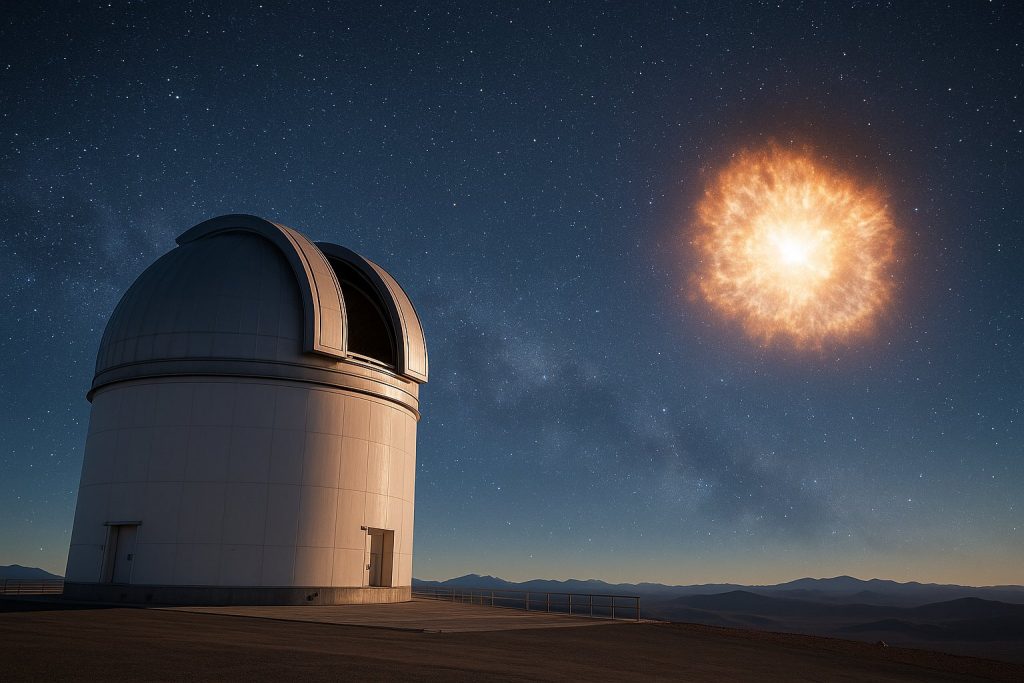
The Paranal Observatory, located in Chile’s Atacama Desert, has achieved a milestone in astrophysics: the Very Large Telescope (VLT) recorded the death of a star just 26 hours after the phenomenon was first detected.
The event corresponds to supernova SN 2024ggi and stands among the earliest and most detailed observations of a stellar explosion ever made.
Supernovas mark the violent end of massive stars after they exhaust their nuclear fuel. While astronomers have studied many such explosions, this is the first time the VLT has captured one at such an early stage, allowing scientists to analyze its geometric structure right after the blast.
The discovery was led by Yi Yang, an assistant professor at Tsinghua University in Beijing, who detected the supernova on April 10, 2024.
Yang quickly submitted an observing proposal to the European Southern Observatory (ESO), which approved the request. The VLT then targeted the event on April 11, roughly a day after the initial detection.
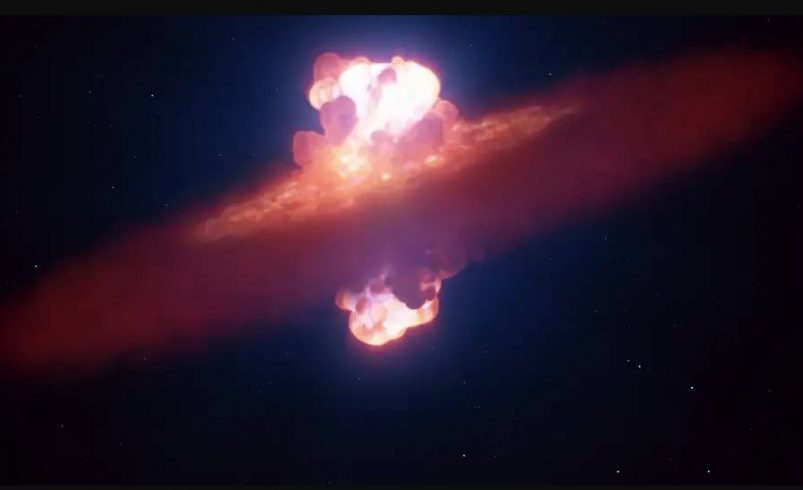
Early observations revealed matter rapidly accelerating from the star’s core and bursting outward. For several hours, astronomers reconstructed the explosion’s shape—a key element in understanding stellar evolution and the mechanisms behind these cosmic detonations.
A star dying in Chile
Using spectropolarimetry, a technique capable of discerning geometric details invisible in conventional observations, researchers determined that the explosion was asymmetrical, resembling an olive in shape.
Understanding this geometry, Yang explained, is essential for deciphering the physical processes that drive supernovae. The full findings were published inScience Advances.
SN 2024ggi lies within the galaxy NGC 3621 in the Hydra constellation, about 22 million light-years away—relatively close in astronomical terms. Evidence suggests it originated from a red supergiant star with a mass between 12 and 15 times that of the Sun and a radius nearly 500 times larger.
The result reinforces Chile’s status as one of the most privileged locations on Earth for observing space, enabling telescopes like the VLT to capture stellar events with exceptional precision.