AI That Restores Identity: A Breakthrough for People Living With ALS
- October 28, 2025
- 0
A Valencian project rebuilds the voice of an ALS patient using artificial intelligence, proving the humanizing potential of technology and its social impact.

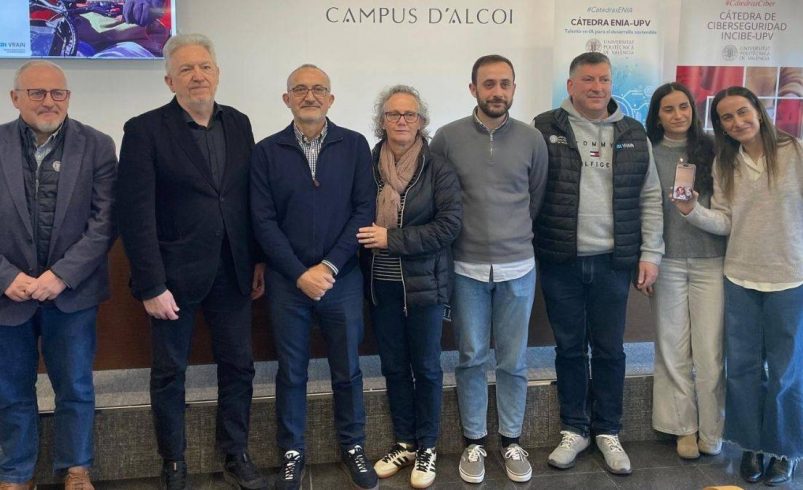
The line between technology and humanity has grown thinner thanks to a pioneering project led by the VertexLit group at ValgrAI and the VRAIN Institute of the Universitat Politècnica de València (UPV).
Their work enabled Fran Vivó, diagnosed with ALS, to recover his own voice through an AI-based cloning system—an emotional and technological milestone that marks a new era for assistive communication.
Voice, one of the most intimate human traits, is often lost as the disease progresses; but this time, artificial intelligence did not come to replace—it came to humanize.
The team faced the immense challenge of rebuilding Fran’s timbre, prosody and natural inflections using just 20 minutes of recordings in Spanish and Valencian, extracted from old WhatsApp voice messages.
This posed an additional difficulty: when Fran lost the ability to speak, voice notes on the app were only beginning to be used, leaving researchers with very limited training material.
To overcome this, the team used neural networks designed to work with extremely small datasets, particularly in Valencian, a language with very few digital audio resources.
They analyzed Fran’s vocal patterns, reconstructed emotional modulations and created an adaptive model capable of generating a fully personalized voice. The result is authentic, reflecting the tones characteristic of Benaguasil and replacing the robotic voice of eye-controlled communication devices.
Behind the technical achievement was a crucial emotional component: the family. Their participation helped adjust intonation, emotional load and intention through an editor that preserves Fran’s unique sound identity.
The tool is also editable, allowing relatives to generate text based on their understanding of what he wants to say, strengthening emotional communication in his immediate environment.
For Jordi Linares, director of VertexLit, the initiative is not about technological prowess but social responsibility. ALS, he stresses, remains an “invisible” disease in public conversation despite its devastating impact on patients and families.
Recreation of Fran’s voice carries symbolic power: “This voice is not just for Fran. It is for all of them.”
Project, carried out entirely on a voluntary basis, seeks to place technology at the service of those who need it most. In the words of Vicent Botti, director of VRAIN and general director of ValgrAI: “This is not an experiment or a demonstration. It is an ethical promise: science must serve those who most need support. Just as Fran speaks again, thousands of voices will also be able to speak.”
The presentation took place during the 2nd Conference of the Valencian Research Institute for Artificial Intelligence (VRAIN), held at the Alcoy Higher Polytechnic School.
Alongside this achievement, researchers showcased developments in automatic subtitling, web review detection and extraction, automated microplastic identification and safety systems for virtual and hybrid interaction environments—demonstrating the broad scope of AI applications.
This project sits at the intersection of research, health and human dignity. For people living with ALS, recovering their voice is not merely a way to communicate—it is a way to recover a part of themselves. AI, often scrutinized for its risks, proves here its capacity to restore rights, such as expressing oneself with one’s own vocal identity.
Technology did more than recreate a voice: it rebuilt a bond. And that may be the beginning of a new era for thousands of people around the world.