Recovered Memory: Spain Identifies Two Republican Victims Linked to Osasuna
December 12, 2025
0
Navarre’s DNA Bank confirmed the identities of Ramón Bengaray and Dionisio Gutiérrez, two Republicans killed in 1936 whose fate remained unknown for decades.
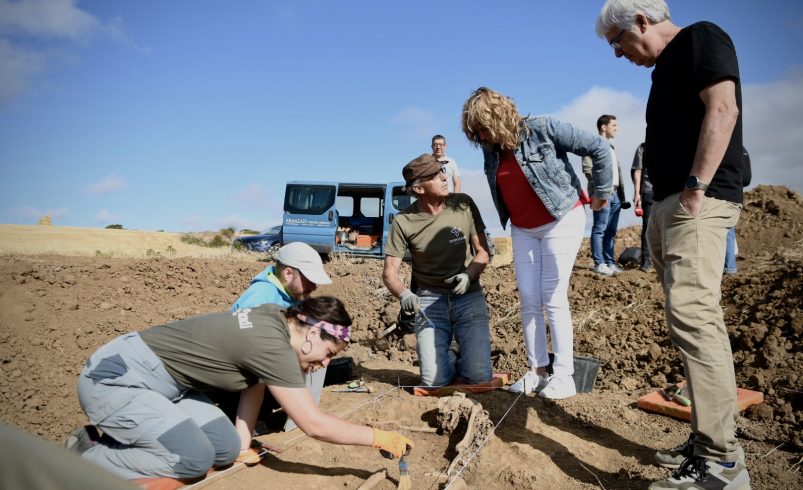
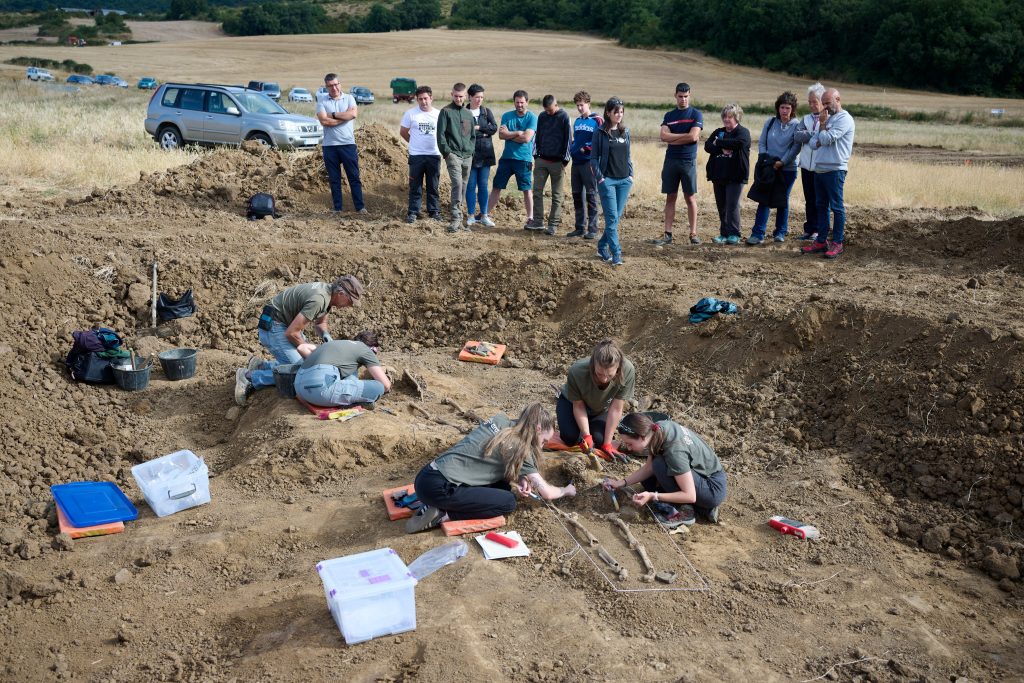
The Government of Navarre has confirmed the identification of the remains of Ramón Bengaray Zabalza and Dionisio Gutiérrez Ijalba, exhumed last summer in Muniáin de Guesálaz.
Both men were executed after the 1936 military coup, in an episode that once again confronts Spain with the responsibility of reconstructing its historical memory.
The identification carried out by the Navarre Institute of Memory and the regional DNA Bank not only provides long-sought biographical clarity but also revives the debate regarding the repression of public figures linked to sports, particularly Club Atlético Osasuna, during the dictatorship of Francisco Franco.
Bengaray, a leading member of Izquierda Republicana and president of the Popular Front in Navarre, was deeply involved in Pamplona’s cultural and social life.
A baritone in the Orfeón Pamplonés, printer, journalist, and athlete, he also served on Osasuna’s board of directors between 1931 and 1935. His disappearance in August 1936 left a historical gap that is only now beginning to be filled.
His remains were found beside those of Gutiérrez, a mechanic from Pamplona who also belonged to a family with left-wing ties.
One of the most notable aspects of the investigation was the role played by the Argentine diaspora. Bengaray’s grandson, living in Argentina, had provided DNA samples years ago, enabling the comparison that confirmed the match.
In Gutiérrez’s case, his son José Luis supplied the genetic material that allowed for verification. According to specialists at the Institute of Memory, no documents had ever located the deaths of either man in Muniáin, making the discovery especially meaningful.
Who were the people involved?
Historical reconstruction shows that Bengaray was detained by the Guardia Civil on August 21, 1936, an event unusually reported in the local press. As for Gutiérrez, although no public record documents his political involvement, his family’s trajectory reveals strong Republican links.
His brother Zósimo served as a carabinero in Lesaka and suffered imprisonment and sanctions under Franco for his loyalty to the Republic, while his sister Juana went into exile in Oloron, France.
The circumstances surrounding their deaths remain unclear. Neither appears in the prisoner records of the Provincial Prison or the fortress of San Cristóbal, a strong indication of extrajudicial execution—common during the early weeks of the war.
The dates provided by their families when registering the deaths coincide with the period of intensifying political violence after the coup. In Navarre, both official police forces and paramilitary groups affiliated with Carlism and the Falange were active.
Their remains were found in 2024 with support from the memory associations Txinparta and Affna 36, technical assistance from Aranzadi Science Society, and testimony from a local resident.
After considering several hypotheses, the DNA Bankdetermined that the remains belonged to Bengaray and Gutiérrez, solving a mystery nearly ninety years old.
The legacy of sport
Bengaray’s legacy is especially significant due to his political and social involvement. He was a founding member of the Larraina club and part of cultural groups such as Los Irunshemes and Los Amigos del Arte. These activities, combined with his political influence, made him a target for the repression under Francisco Franco.
Even after his execution, the dictatorship opened a property-seizure case against him that ended in a fine of 250,000 pesetas. His widow, Ramona Zapatero, fought for years—within the limited legal avenues allowed by the regime—to recover the family’s assets, eventually reducing the sanction to 20,000 pesetas.
Gutiérrez’s political role may not be documented, but the persecution suffered by several members of his family suggests the kind of environment that placed him at risk. His identification almost ninety years later symbolizes the restorative power of forensic science, especially for families still searching for answers.
Experts emphasize that these identifications highlight the importance of gathering genetic profiles, even when historical documentation is scarce.
The grave where they were found had never been located, nor was it expected to contain individuals as historically relevant as Bengaray and Gutiérrez. Bengaray’s granddaughter expressed surprise and relief at the finding, while Gutiérrez’s grandson described the moment as a “liberating presence” after 89 years of silence.
According to the Navarre Institute of Memory, these advances underscore the importance of expanding public policies focused on historical recovery.
The stories of Bengaray and Gutiérrez illustrate the human cost of the repression imposed by Francisco Franco, while also demonstrating that scientific tools can help restore truth and dignity. Even when memory seems buried, it can be reconstructed through historical rigor, genetic technology, and collective commitment to justice.