European farmers paralyze Brussels and intensify opposition to the EU–Mercosur deal
- December 19, 2025
- 0
Thousands of farmers blocked Brussels, demanding stronger CAP funding and rejecting the trade deal between the European Union and Mercosur.

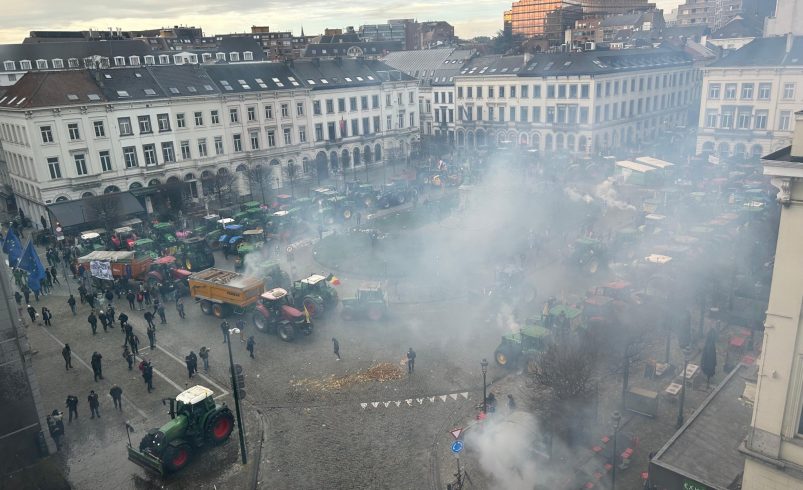
Thousands of farmers and livestock producers from across the European Union took to the streets of Brussels, Belgium, on Thursday to protest against the EU–Mercosur trade agreement and warn about potential cuts to the Common Agricultural Policy (CAP), a cornerstone of European integration.
The demonstration, which began at midday, gathered more than 10,000 protesters, including delegations from Spain, France, Italy, and Eastern Europe.
Hundreds of tractors flooded the Belgian capital, blocking major roads and causing traffic chaos, while clashes erupted with police forces attempting to disperse the crowd using tear gas.
The protests coincided with a European summit in Brussels, where EU leaders are primarily discussing financial support for Ukraine amid the ongoing war with Russia.
However, growing social pressure has pushed the Mercosur agreement back into the political spotlight as the European Commission seeks to finalize the long-negotiated deal.
The trade agreement between the European Union and Mercosur—which includes Brazil, Argentina, Uruguay, and Paraguay—has been under negotiation for more than 25 years and is seen by Brussels as a strategic economic partnership.
Farmers, however, argue that it threatens their livelihoods by opening the door to cheaper agricultural imports.
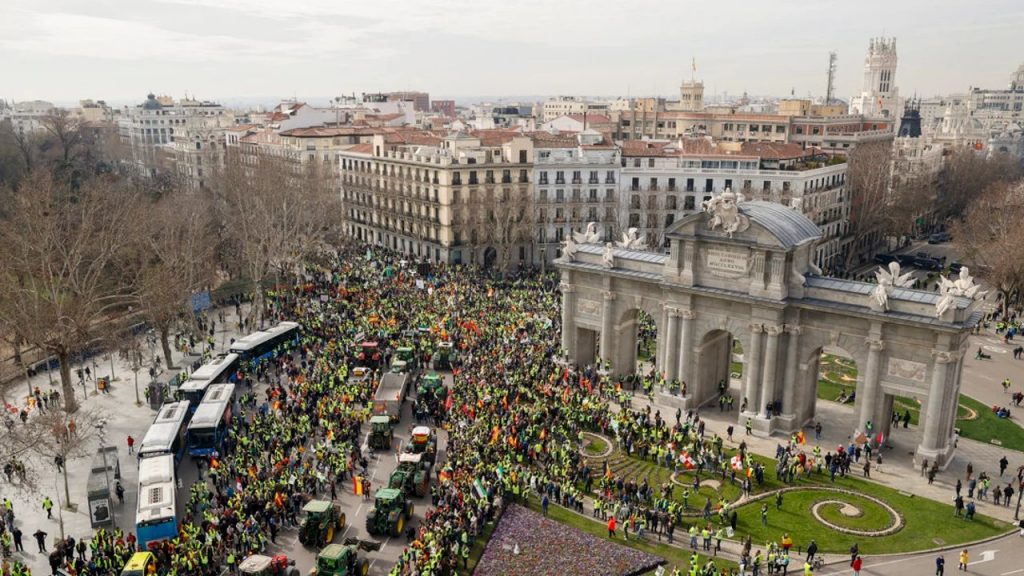
Protesters claim that products from Mercosur countries are produced under weaker environmental, labor, and sanitary standards than those imposed within the European Union, creating what they describe as unfair competition. They are demanding “mirror clauses” to ensure equal rules for all imported goods.
Concerns have also intensified over potential reductions to the CAP budget for the 2028–2034 period. Agricultural organizations warn that funding cuts could devastate family farms and undermine the EU’s food security.
European Commission President Ursula von der Leyen met with Copa–Cogeca representatives earlier in the day, describing the talks as “productive” and pledging continued support for farmers.
Yet demonstrators remain unconvinced, insisting that concrete guarantees are still missing.
As negotiations continue behind closed doors in Brussels, Europe’s farmers have made it clear that resistance to the EU–Mercosur deal is far from over, highlighting once again the deep tensions between free trade ambitions and agricultural protection within the European Union.