Southern Separatists Challenge Riyadh and Abu Dhabi in a Move That Reshapes Yemen’s Power Map
December 11, 2025
0
A separatist takeover of key southern areas in Yemen heightens tensions with Saudi Arabia and the United Arab Emirates (UAE), exposing rifts within the anti-Houthi coalition.
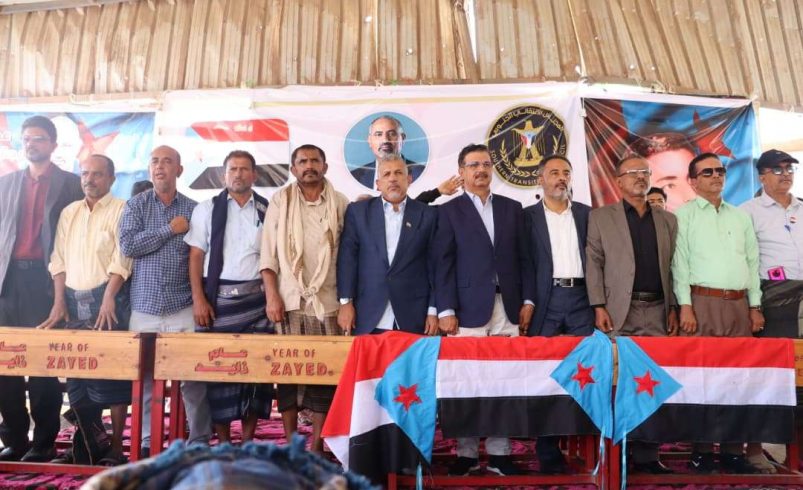
Political and military tensions in Yemen escalated sharply after the Southern Transitional Council (STC), a separatist group backed by the United Arab Emirates (UAE), seized strategic territory in Hadramaut, including key oil facilities.
The move has deepened divisions within the bloc fighting the Iran-aligned Houthi rebels and triggered a temporary shutdown of Yemen’s airspace, highlighting rising friction withSaudi Arabia, the main force leading the military coalition in the country since 2015.
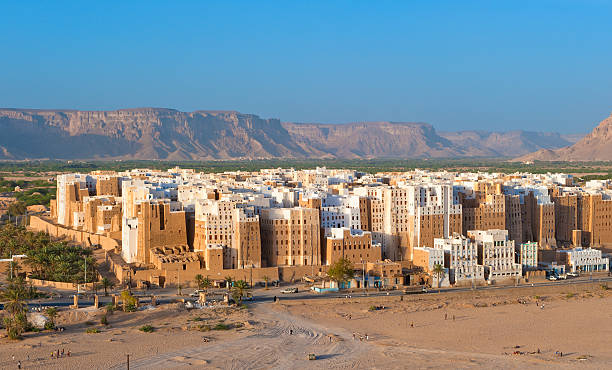
“Panorama of Shibam, Hadhramaut province, Yemen”
On Monday, a Yemeni government official confirmed that the country’s airspace was briefly closed after the coalition led by Saudi Arabia refused to authorize flight permits — including those for arrivals and departures in Aden, the seat of the internationally recognized government.
According to the official, the shutdown served as a “Saudi message” to the STC following its recent advance and takeover of strategic zones in Hadramaut. The maneuver adds pressure to an already fractured conflict that could lead to Yemen splitting again into two states, more than three decades after unification. Riyadh did not publicly acknowledge ordering the closure.
However, since its intervention in 2015, the coalition led by Saudi Arabia has maintained operational control of Yemen’s airspace. As a result of the temporary suspension, hundreds of passengers were stranded for hours until flights resumed.
Staff at Aden International Airport assisted affected travelers, including those preparing for a Cairo-bound flight scheduled to depart earlier in the day.
The separatist advance
The STC — a coalition of armed groups trained and funded by the United Arab Emirates (UAE) — has rapidly expanded its presence across southern Yemen in recent weeks.
Its forces seized control of Seiyun in Hadramaut, capturing oil fields, energy facilities, and key government buildings, including the airport and the presidential palace. Among the assets taken was PetroMasila, Yemen’s largest oil company.
STC units also deployed across Wadi Hadramaut, a strategic region housing major urban centers and military bases. From there, they advanced toward Mahra, the easternmost province bordering Oman
. Throughout these areas, STC forces raised the flag of South Yemen — the banner used by the former People’s Democratic Republic of Yemen — over government offices, customs points, and schools.
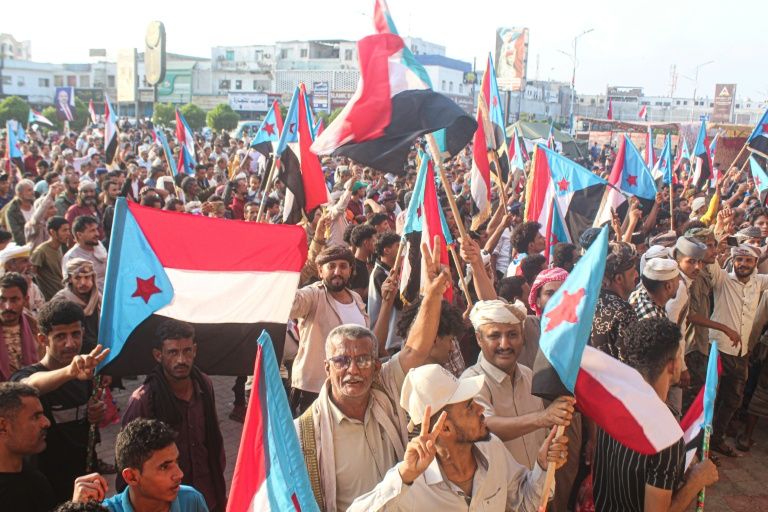
The separatist push triggered public demonstrations in Aden and Hadramaut, where hundreds of STC supporters filled the streets demanding the reestablishment of an independent southern state.
Protesters waved South Yemen flags and displayed portraits of Aidarous al-Zubaidi, the STC leader and vice president of the country. For many, the military advance represented a long-awaited turning point; one resident described it as “the day of victory,” pledging to remain in the streets until independence is formally declared.
Yemen’s war began in 2014, when the Houthis seized Sana’a and much of the north. The following year, the coalition led by Saudi Arabia launched a military intervention aimed at restoring the internationally recognized government.
Government reaction and regional stakes
Rashad al-Alimi, president of Yemen’s Presidential Leadership Council, called on forces backed by the United Arab Emirates (UAE) to withdraw from the areas recently captured in Hadramaut and Mahra.
In a statement issued from Riyadh after meeting with diplomats from the US, the UK, and France, Al-Alimi rejected any unilateral action that could “undermine the legal status of the state or create a parallel reality.”
Regional analysts warn that the STC’s latest move constitutes a “major shift” in Yemen’s conflict dynamics. Ahmed Nagi, a Yemen specialist at the International Crisis Group, argued that the United Arab Emirates (UAE) has emerged as “the main winner,” extending its territorial and political influence across the southern half of the country.
According to Nagi, the central question now is how Saudi Arabia will respond, given the direct implications for its national security.
For now, forces supported by the UAE control nearly all of southern Yemen, including critical coastal areas, the strategically located island of Mayun in the Bab el-Mandeb strait and the volcanic island of Socotra in the Indian Ocean.
UAE’s longstanding support for the separatist movement has repeatedly strained its relationship with Saudi Arabia, despite both countries being part of the same coalition fighting the Houthis.
Although Abu Dhabi issued a statement on Monday asserting that its position on the Yemen crisis “aligns fully” with that of Saudi Arabia and backing international efforts to revive a political process, realities on the ground reflect competing regional ambitions.
More than a decade later, Yemen remains mired in overlapping power struggles, with local factions and regional powers contesting territory, resources, and political legitimacy.