Caracas Accuses Washington of Expanding Military Pressure to Control Venezuelan Oil
- December 1, 2025
- 0
Venezuela asked OPEC for support, alleging a U.S. military escalation that threatens its sovereignty, its oil sector, and global energy stability.

Venezuela asked OPEC for support, alleging a U.S. military escalation that threatens its sovereignty, its oil sector, and global energy stability.
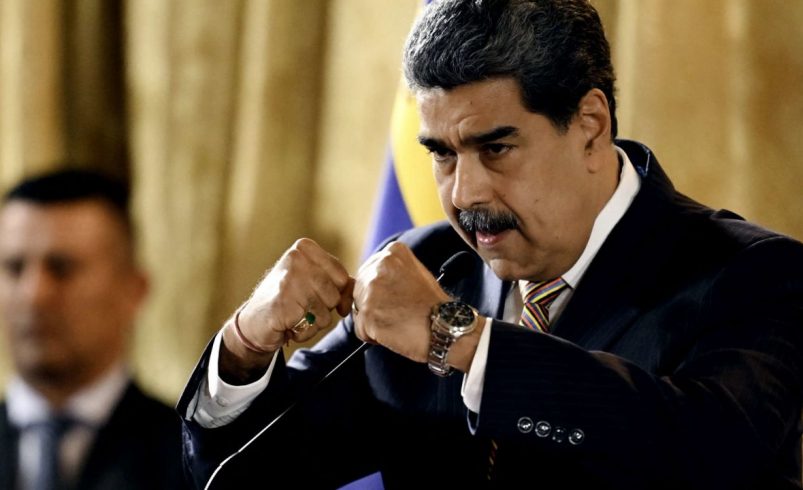
Venezuela escalated its confrontation with the United States on Sunday by formally requesting the intervention of the Organization of the Petroleum Exporting Countries (OPEC).
President Nicolás Maduro’s government contends that Washington is executing a military and political strategy designed to destabilize Venezuela and “seize” its vast oil reserves—the largest in the world.
In the letter, Maduro argues that the United States is driving “an aggression that grows stronger each day,” supported by a military operation in the Caribbean that, according to Caracas, far exceeds Washington’s stated objective of combating drug trafficking.
“A military action against Venezuela puts at grave risk the stability of Venezuelan oil production and the global market,” he warned. The government is seeking support from OPEC Secretary General Haitham Al Ghais and the OPEC+ alliance, insisting that the escalation affects both producers and consumers.
The U.S. military deployment includes destroyers, fighter jets, thousands of personnel, and the world’s largest aircraft carrier—marking the most significant regional operation since the Cuban Missile Crisis.
Caracas maintains that these maneuvers are not aimed at drug interdiction but at creating conditions for a government change.
This perception deepened after the U.S. president confirmed that he recently spoke by phone with Maduro, though he shared few details. At the same time, senior Republican officials claimed that Washington offered Maduro safe passage to other nations, including Russia.
Diplomatic tensions intensified alongside a tightening of airspace restrictions. The U.S. president warned airlines and pilots that Venezuelan airspace should be considered “completely closed,” while the Federal Aviation Administration (FAA) advised extreme caution when flying over Venezuela and the southern Caribbean due to possible military activity.
In response, Venezuelan aviation authorities revoked the permits of several foreign airlines, accusing them of aligning with what they described as a “terrorist” strategy promoted by Washington.
This isolation has direct consequences for thousands of Venezuelans stranded abroad. Maduro ordered a “special plan” to ensure their return and maintain outbound flight routes for those who must travel.
According to Rodríguez, Venezuela will activate “all multilateral mechanisms” to demand the immediate cessation of these actions, which she labeled “illegitimate and unlawful.”
The situation escalated further when Venezuela filed a formal complaint before the International Civil Aviation Organization (ICAO), denouncing a violation of its sovereignty and warning that U.S. military operations threaten “hemispheric security.”
Meanwhile, U.S. officials reported the destruction of 20 vessels allegedly involved in drug trafficking, operations they claim resulted in at least 83 deaths. Caracas rejects these assertions, arguing that the attacks occurred in waters near Venezuelan territory and represent a direct threat, causing the deaths of Venezuelan citizens.
From the Pentagon, Defense Secretary Pete Hegseth dismissed the allegations as “false” and “pejorative,” insisting the operations were lawful.
In Venezuela, National Assembly President Jorge Rodríguez publicly stated that Venezuelan citizens were among the victims of the U.S. attacks. Rodríguez, the government’s main interlocutor with Washington, said he met with relatives of the deceased and will propose the creation of a parliamentary commission to investigate the events.
As the crisis unfolds, OPEC now faces the challenge of evaluating Venezuela’s appeal in a global environment already shaped by energy tensions, fluctuating oil prices, and geopolitical conflict. Caracas hopes the bloc will act as a stabilizing force, help prevent further escalation, and defend the interests of oil-producing nations.
According to the Venezuelan government, the current U.S. strategy endangers not only the country’s territorial integrity, economic structure, and sovereign rights, but also the broader energy balance on which global markets depend.