Ecuador’s referendum defeat stalls Noboa’s reforms and reshapes the political landscape
- November 17, 2025
- 0
The “No” vote prevailed in all four referendum questions in Ecuador, halting Noboa’s reform agenda and triggering a new political scenario.

The “No” vote prevailed in all four referendum questions in Ecuador, halting Noboa’s reform agenda and triggering a new political scenario.
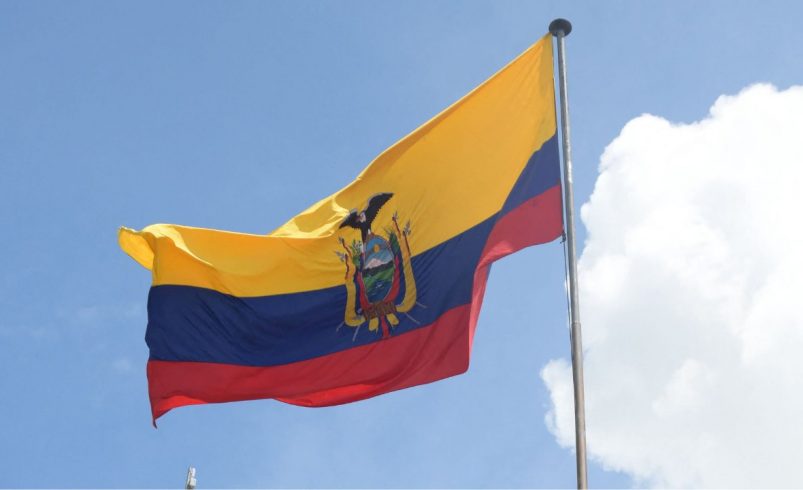
The sweeping victory of the “No” vote in Ecuador’s referendum and popular consultation on Sunday delivered a clear message: the public rejected the institutional reform package promoted by President Daniel Noboa.
According to the National Electoral Council (CNE), the “No” vote prevailed across all four questions with broad margins: around 60% against allowing foreign military bases; 57% opposing the elimination of public funding for political parties; 53% rejecting the reduction of the National Assembly; and nearly 61% voting against convening a Constituent Assembly.
With the outcome clear, Noboa swiftly accepted the verdict: “These are the results. We consulted Ecuadorians, and they have spoken,” he posted on X.
He added that his administration would continue working “with the tools we have,” acknowledging that his structural reform agenda has been decisively blocked.
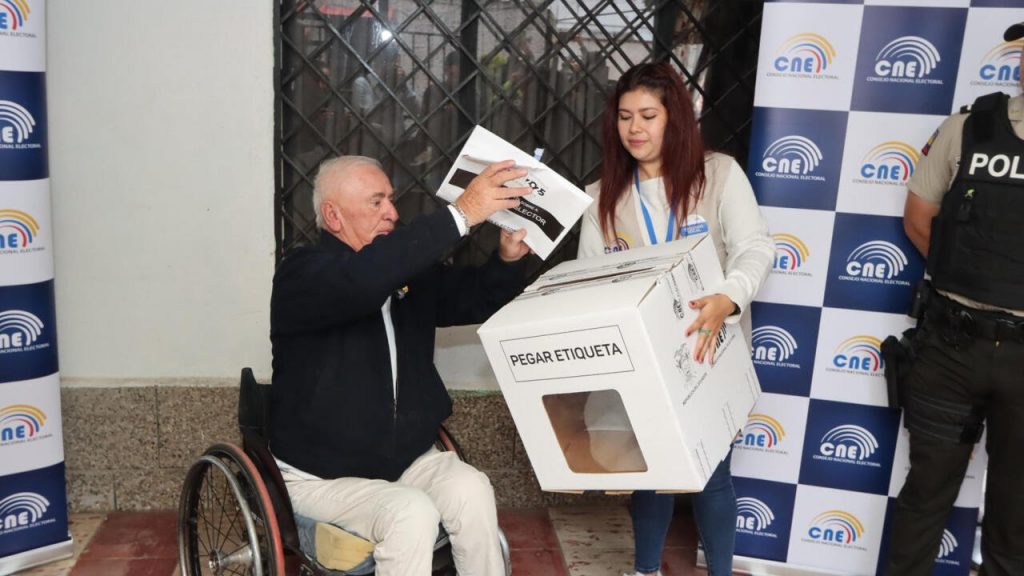
The four proposals sought to overhaul key components of the institutional framework established under the 2008 Montecristi Constitution.
First initiative aimed to abolish the explicit ban on stationing foreign military bases on Ecuadorian soil, replacing it with a vague definition describing Ecuador as a “territory of peace.”
Second sought to eliminate permanent public funding for political parties; the third cut the National Assembly from 151 to 73 seats; and the fourth asked voters to decide whether to convene an 80-member Constituent Assembly to draft a new Constitution, which would later be subject to another referendum.
The rejection carries several layers of interpretation but sends at least three clear signals about the country’s political mood. First, voters —especially younger ones, with 26.7% between ages 18 and 29 and nearly half under 40— did not endorse the government’s reformist push. Noboa framed the proposals as a response to the security crisis and a means to modernize political institutions.
Yet a significant share of the electorate chose to preserve the status quo: foreign military bases remain banned, public party funding stays intact, the Legislature will not shrink, and the 2008 Constitution will not undergo a constituent overhaul.
Second, resistance groups managed to mobilize despite a short campaign with no official debates. The CNE authorized 16 political and social organizations to campaign for either Yes or No.
Those backing the “No” included the Confederation of Indigenous Nationalities of Ecuador (Conaie), unions, and opposition parties —groups often distant from one another but united in their criticism of foreign military involvement, the elimination of public party funding, and the potential concentration of power through a constituent process.
The government, Noboa’s ADN movement, and parties like CREO defended the reforms as tools for transparency and efficiency, but failed to overcome broad public skepticism.
Third, the national context proved decisive. Ecuador arrived at these elections after years of instability: a succession of presidents unable to finish their terms, the early dissolution of the Assembly in 2023, and a surge of criminal violence that has turned the country into one of the most dangerous in the region.
In this climate, Noboa pursued a plebiscitary strategy just seven months after winning the presidency. But the official campaign, driven largely by social media with minimal technical explanation, did not succeed in persuading voters to adopt major reforms.
While they celebrate stopping Noboa’s reforms, opposition parties and social movements now face the challenge of proposing viable alternatives. The “No” vote acts as a brake on systemic redesign but does not constitute a mandate for another political bloc.
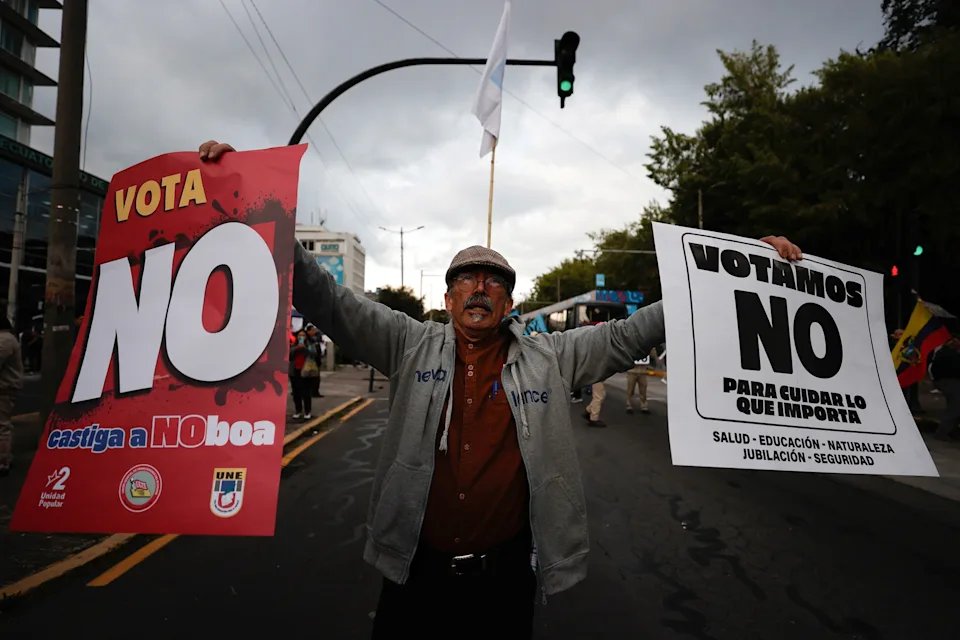
The 2008 Constitution, produced through a broad constituent process led by Rafael Correa, left a mixed legacy. It expanded rights and oversight institutions but was also seen as a vehicle for strengthening presidential power.
Many voters viewed Noboa’s proposals as a possible repeat of such structural reshaping, this time under his leadership.
His attempt to reshape the legislative landscape, gain broader authority for security agreements with foreign powers, and set the stage for a new Constitution has been blocked.
He must now govern with the existing institutional framework, a fragmented Assembly, economic fragility and an escalating security crisis.
For the opposition, the triumph of the “No” vote is meaningful but not definitive. Without a unified leadership or coherent proposal, they cannot convert the result into an immediate political shift.
Meanwhile, voters opted for caution: no constitutional overhaul, no drastic cut to legislative representation, no change to party financing, and no opening —for now— to foreign military bases on Ecuadorian territory.