Elections in Singapore: People’s Action Party Secures Another Historic Win
May 15, 2025
0
The ruling People's Action Party in Singapore maintains its long-standing dominance with a decisive victory, strengthening Prime Minister Lawrence Wong's leadership.
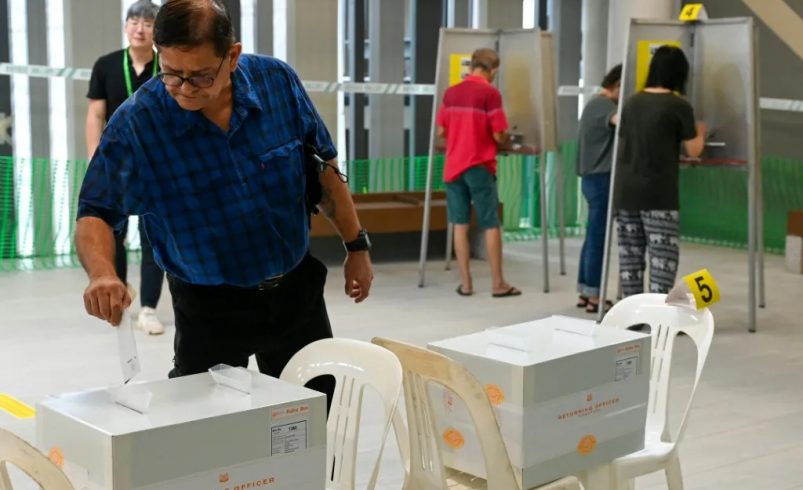
The People’s Action Party (PAP) of Singapore extended its historic 66-year rule following a resounding victory in the general elections held this Saturday.
According to the Electoral Department, the PAP won 82 contested parliamentary seats, in addition to five uncontested, bringing its total to 87 seats. Meanwhile, the Workers’ Party, the main opposition, retained its 10 seats.
Ahead of the official announcement, PAP supporters gathered in a stadium, waving flags and cheering for Prime Minister Lawrence Wong, who took office just over a year ago.
“These results will put Singapore in a stronger position to face a turbulent world,” Wong said, also expressing gratitude for the voters’ strong mandate. He acknowledged the need for alternative voices in Parliament but emphasized that a strong PAP team is essential to tackle future challenges.
Wong, a 52-year-old economist trained in the United States, succeeded Lee Hsien Loong, who stepped down in May 2024 after more than two decades as prime minister. Lee’s departure marks the end of a family dynasty that began with his father, Lee Kuan Yew, the architect of Singapore’s economic rise since independence.
Prime Minister Lawrence Wong
As prime minister and finance minister, Wong faces the challenging task of guiding the city-state, heavily reliant on trade, amid uncertainty caused by U.S. tariffs, prompting the Singaporean government to revise trade forecasts and warn of a possible recession.
Singapore’s new political landscape
Despite maintaining power, the PAP faces internal challenges. Its share of the popular vote dropped to 61% in 2020 from nearly 70% in 2015, reflecting growing discontent among younger voters over high living costs, unaffordable housing, income disparity, and restrictions on freedom of expression.
The opposition argues that a more balanced Parliament would allow greater accountability and diverse perspectives but is often hindered by limited resources and fragmented support.
To strengthen leadership, Wong brought 32 new members into the PAP after veteran retirements and has sought to engage younger voters through social media.
He also promised policies promoting a more inclusive and equitable Singapore, aiming to maintain the stability and prosperity that have defined the country for more than six decades.
Overall, the election results reinforce PAP’s dominance and consolidate Lawrence Wong as the central leader of Singapore, while highlighting the challenges the city-state faces in balancing economic growth, political stability, and social demands in an increasingly complex global context.